


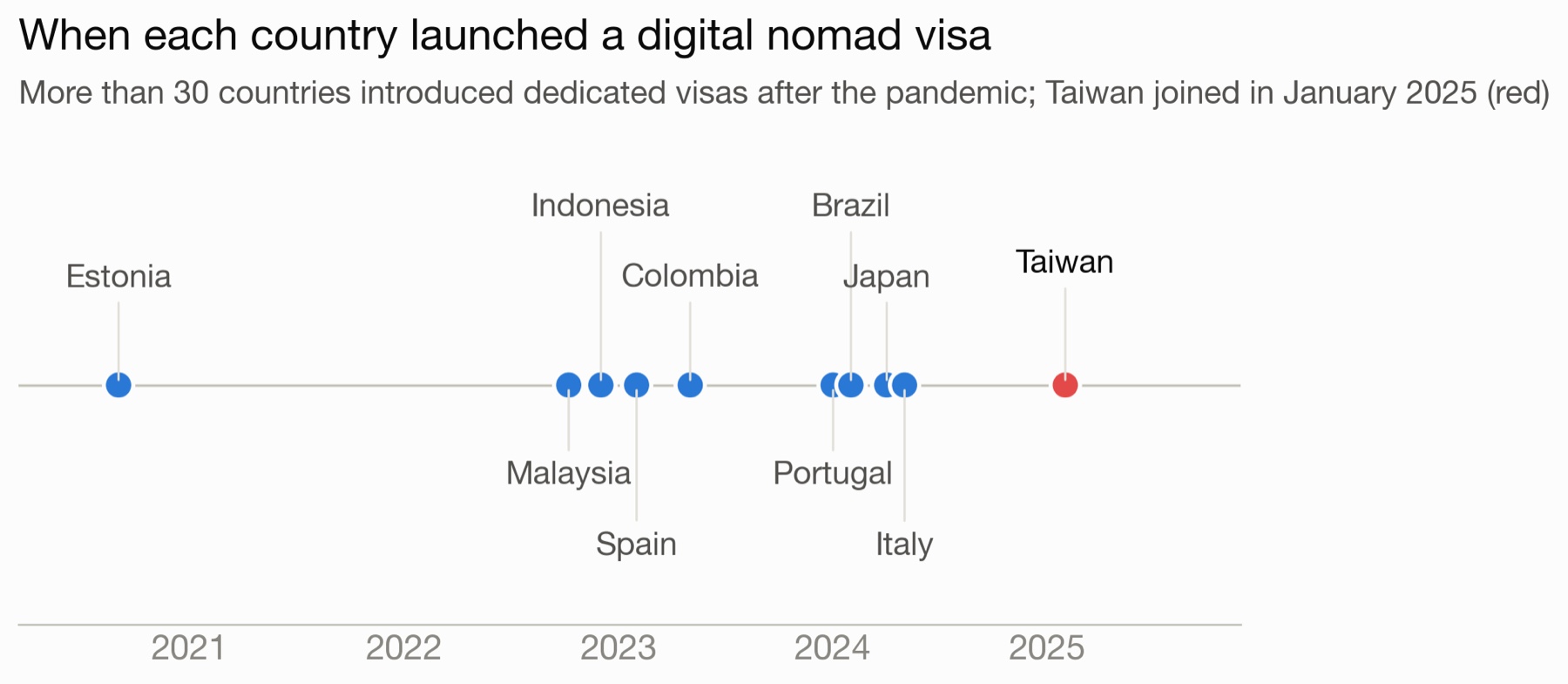
In January 2025, Taiwan launched its Digital Nomad Visa, joining more than thirty countries competing for high-mobility talent. One year on, the questions worth asking are simple: who came, how long did they stay, what did they spend — and what is still missing?
Between May and December 2025, the Taiwan Digital Nomad Association (TDNA) collected 1,071 in-person survey responses in Taipei and Taichung, and a further 434 responses online — 1,505 in total. It is the largest first-hand dataset on digital nomadism in Taiwan to date, and the first to capture both sides of the ecosystem: international nomads coming to Taiwan, and Taiwanese nomads moving within it.
This excerpt edition is free to read and free to cite. Please attribute as: Taiwan Digital Nomad Association (2026). The State of Digital Nomadism in Taiwan 2025 — Excerpt Edition.
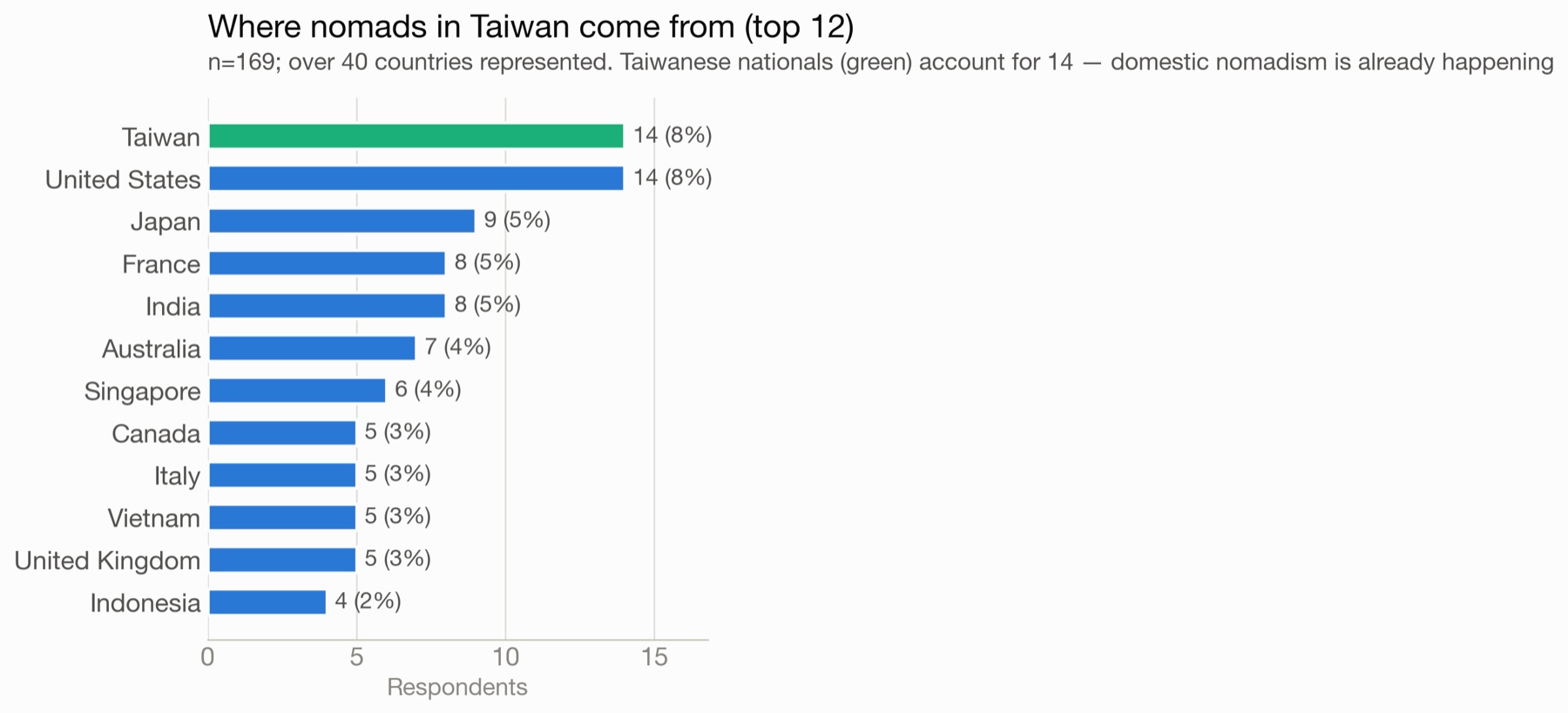
- In TDNA’s 2025 survey of 1,505 respondents, digital nomads in Taiwan came from more than 40 countries, with no single nationality above ten percent.
- Nomads in Taiwan spend an average of USD 2,159 per month and stay about five months, generating an estimated USD 12,662 per stay — roughly ten times the average inbound tourist trip (USD 1,276; Tourism Administration, 2024).
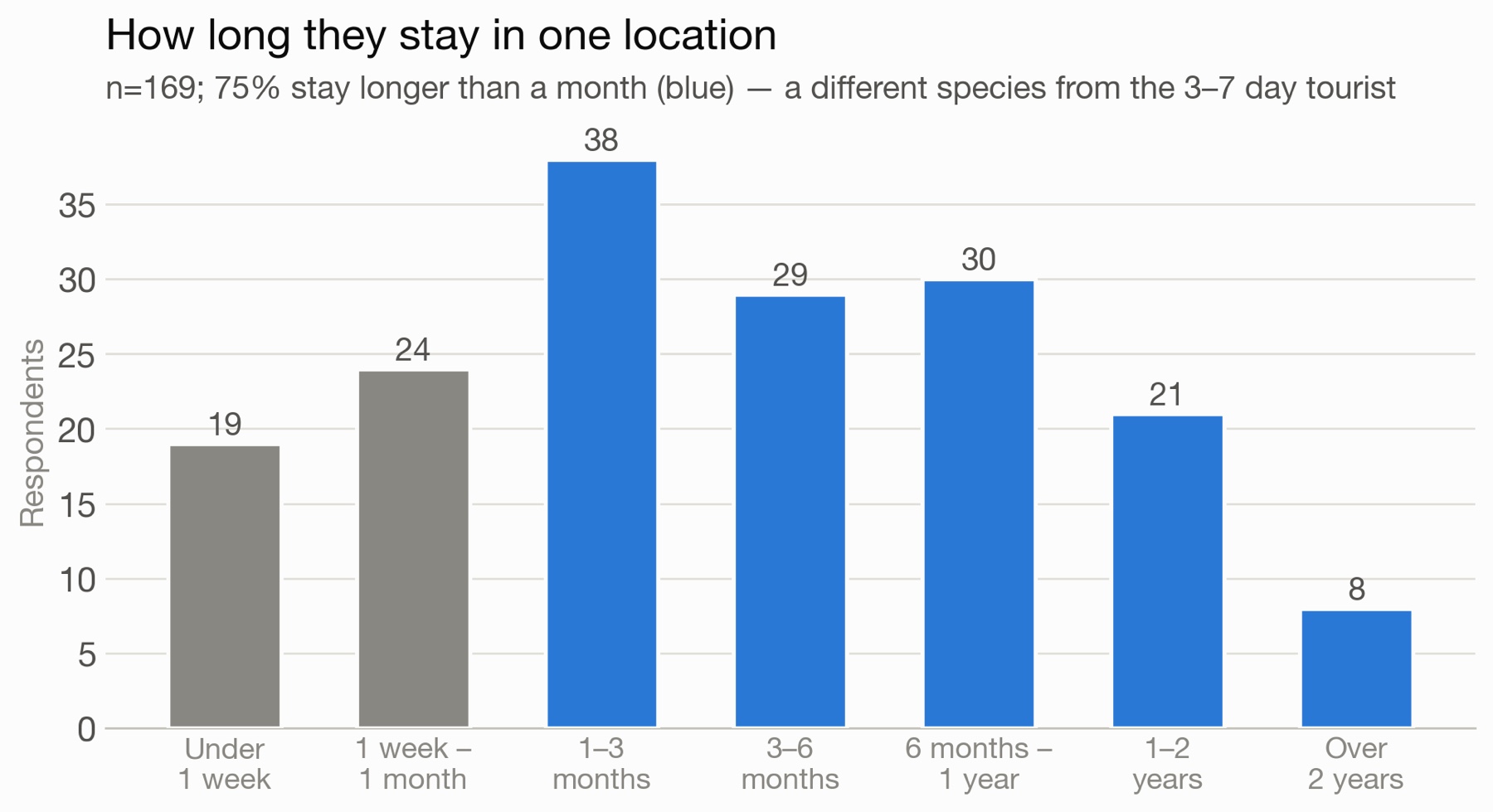
- 75% of surveyed nomads stay longer than one month in a single location, and 53% were visiting Taiwan for the first time.
- 266 Taiwanese respondents already practise digital nomadism inside Taiwan; their most-wished destination is Taitung (18%).
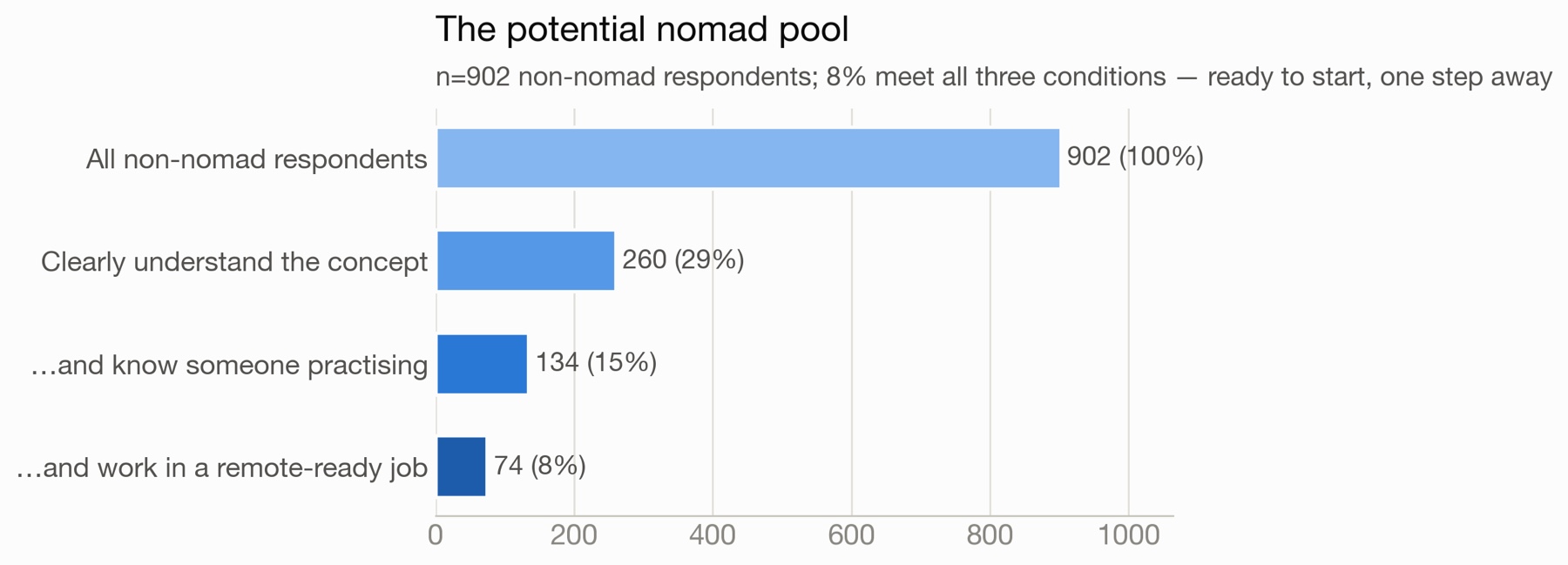
- 8% of non-nomad respondents meet all three readiness conditions — understanding, peer network and a remote-ready occupation.
Six key figures
| 40+ countries | of origin among nomad respondents — no single nationality dominates |
| USD 12,662 | estimated local spending per stay — roughly ten times an average inbound tourist trip |
| 75% | stay longer than one month per location — long stays are the norm, not extended tourism |
| 53% | are first-time visitors to Taiwan — the visa’s first year opened a new audience |
| 266 people | Taiwanese already nomading domestically — their most-wished base is Taitung |
| 8% | of non-nomad respondents are “ready to start”: they understand the concept, know practitioners, and work in remote-ready jobs |
Eleven findings
1. Year one attracted the right people
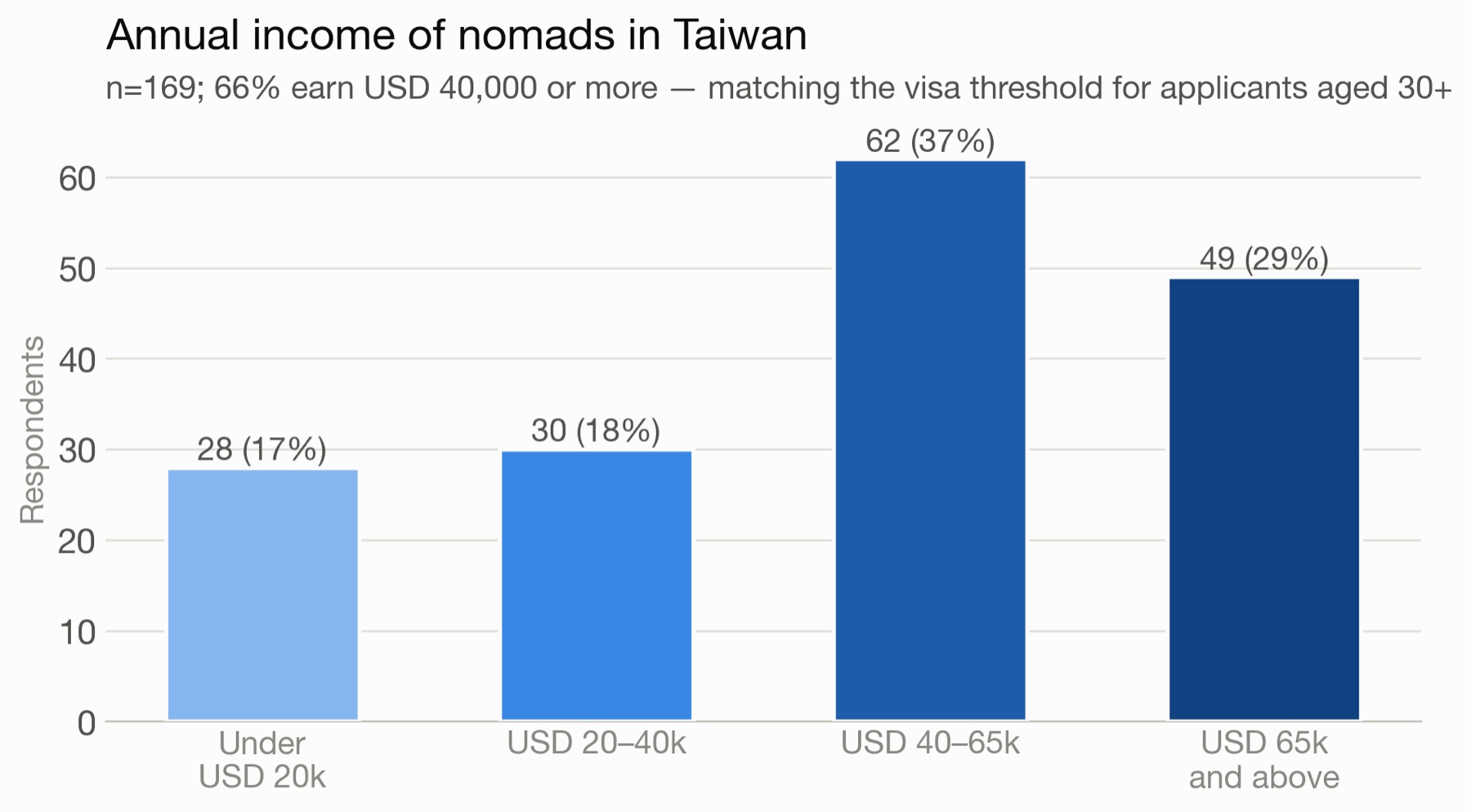
Nomad respondents come from over 40 countries and territories, with no single nationality above ten percent. 66% are aged 25–44, and 66% earn USD 40,000 or more — closely matching the visa’s income threshold. The policy filter is pointed in the right direction.
2. They are experienced, not experimenting
Half of practising nomads have three or more years of experience; 70% have visited more than ten countries. They have lived in Chiang Mai, Bali and Lisbon. Taiwan was a considered choice, not a whim — which also makes their assessment of it unusually well-calibrated.
3. Their work is remote-delivered, not locally competing
Four occupation groups — IT and engineering, education and research, freelance and entrepreneurship, design and creative media — account for about 55%. They serve overseas employers and clients, occupy no local headcount, and bring international projects and working methods into Taiwan’s coworking spaces.
4. Long stays are the norm
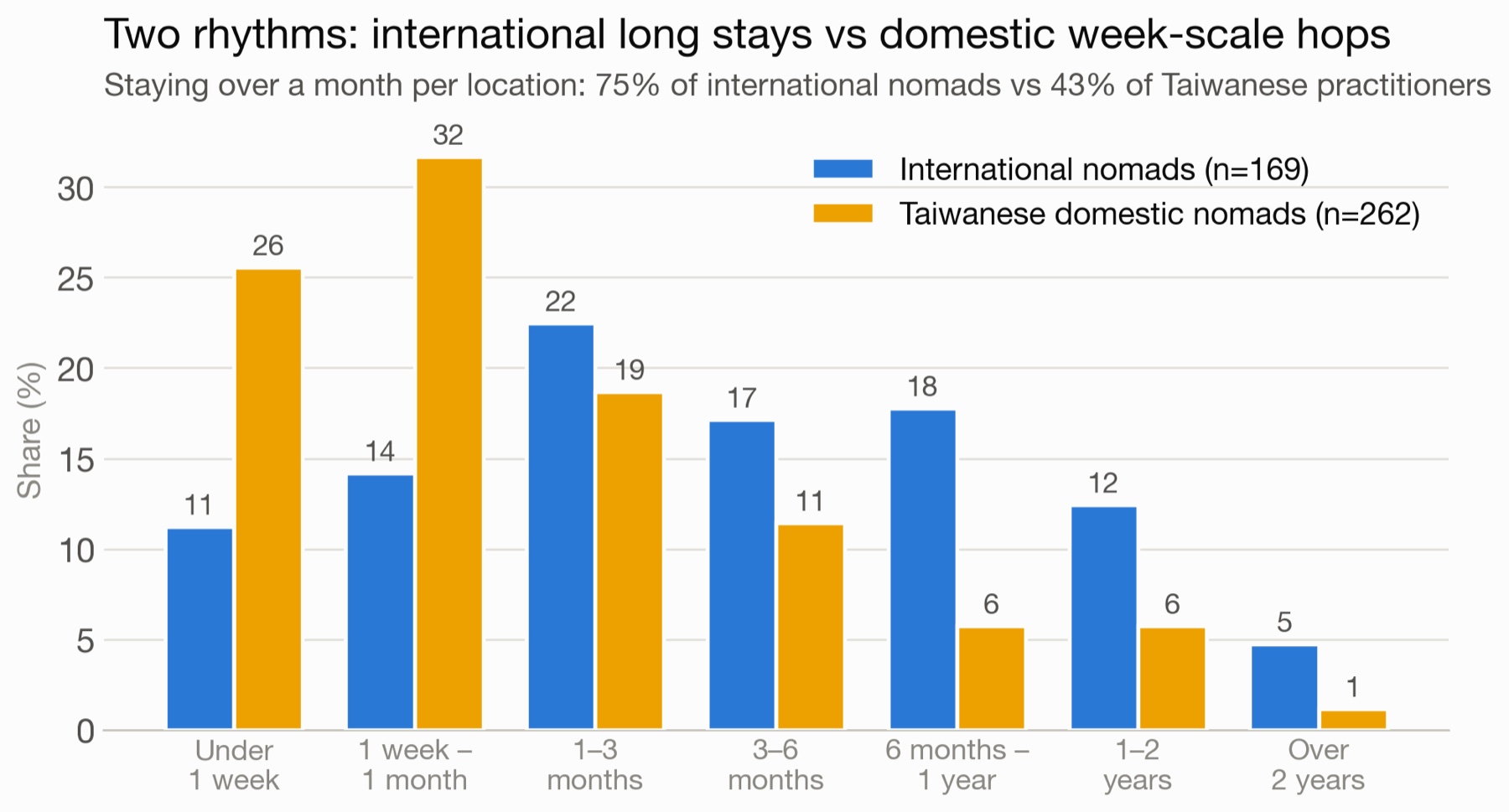
75% stay longer than a month in a single location, most commonly one to three months, spending an average of USD 2,159 per month. They rent apartments rather than book hotels, shop at markets rather than tour attractions, and use local mobile plans and healthcare.
5. One nomad ≈ ten tourist trips
Combining self-reported spending and stay length, an average nomad’s stay generates an estimated USD 12,662 in local spending — about ten times the average inbound tourist trip (approx. USD 1,276; Tourism Administration statistics, 2024). Using medians, the multiple is still above three. Daily spending is lower than a tourist’s, but the volume, duration and destination of the money are entirely different.*
6. Culture is the strength; housing and information are the gaps
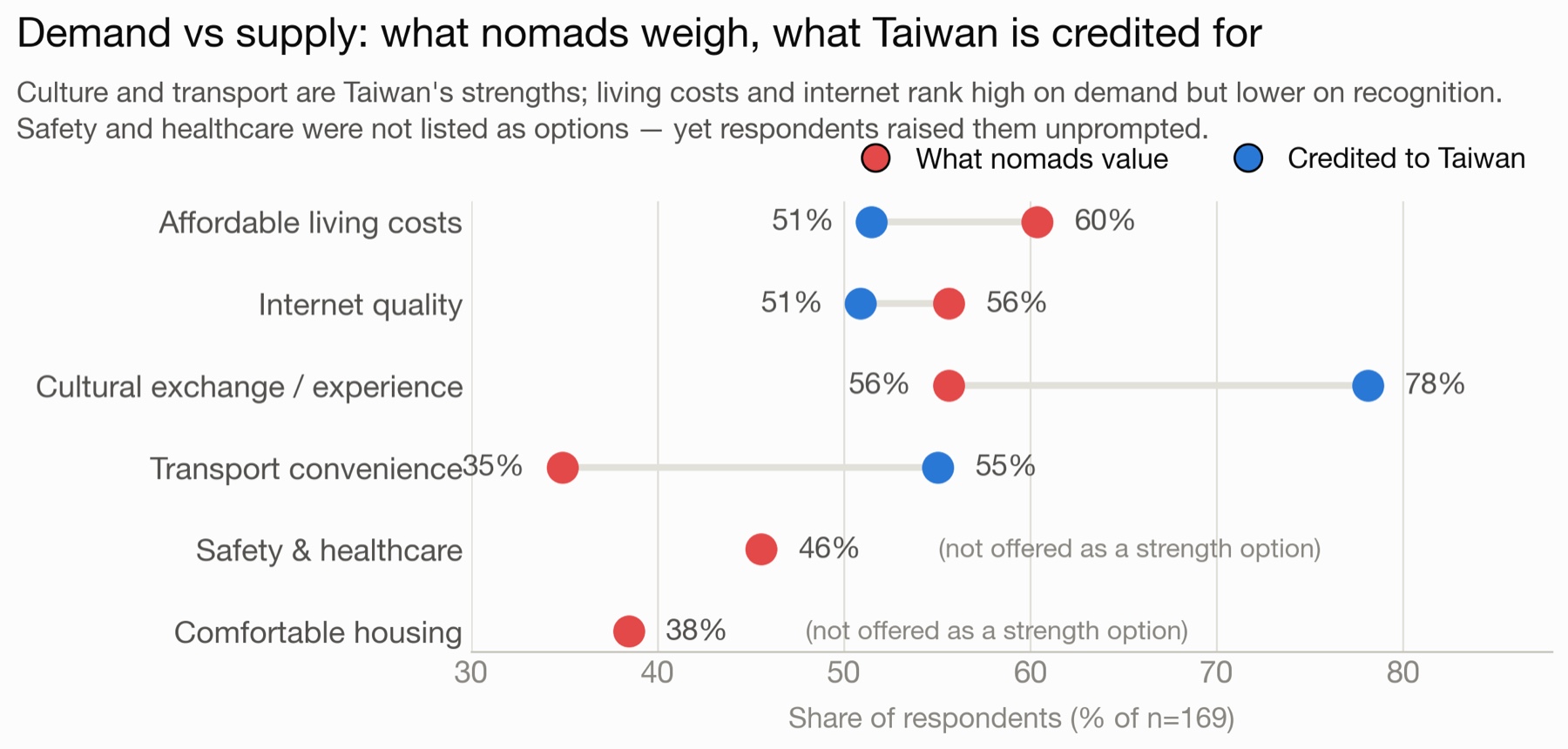
78% recognise Taiwan’s cultural richness. But on the two factors nomads weigh most heavily — affordable living costs (60%) and internet quality (56%) — Taiwan’s recognition lags at 51% each. The core of the gap is mid-term housing: few monthly rental options, and rental information that is hard for foreigners to navigate.
7. An underrated asset: safety, democracy and hospitality
“Safety” was not among our listed options — yet nearly 20 respondents wrote it in themselves: Friendly people. Safe environment. Democracy and hospitality. Open to LGBT. This echoes Taipei’s ranking as the world’s safest city for female digital nomads (Holidu). These are the words nomads chose; they belong at the centre of how Taiwan presents itself.
8. Taiwanese are already nomading — at home
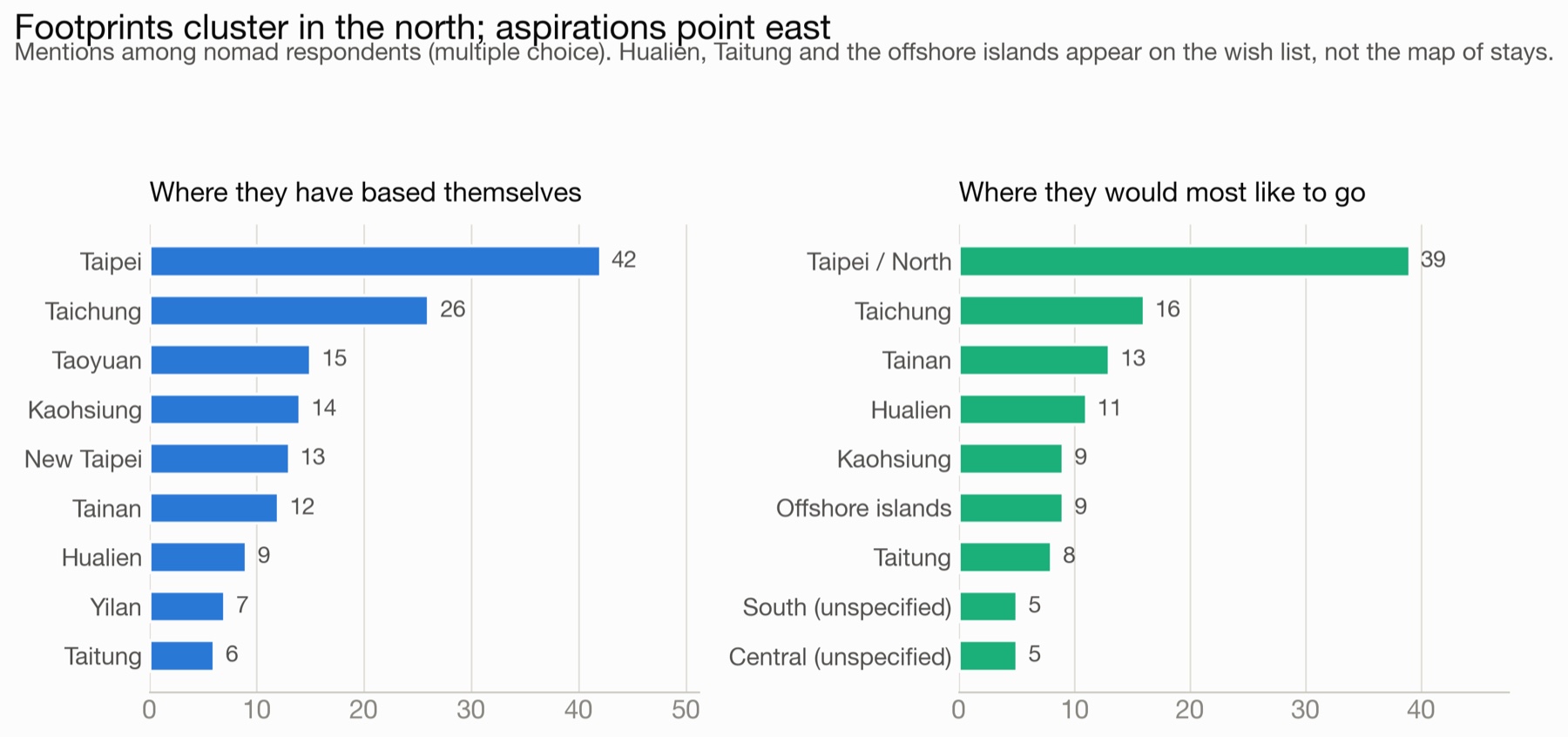
Of 434 online respondents (91% Taiwanese), 266 already practise digital nomadism domestically — but to a different rhythm: 57% stay under a month per location, moving in week-scale hops, and half spend under USD 1,000 a month. Their footprints follow the western corridor, yet their most-wished destination is Taitung (18%) on the east coast. Domestic nomads are the weekday clientele of coworking spaces, the organisers of community events, and the first local friends international nomads make.
9. A real pipeline: one in twelve is ready to start
Among non-nomad respondents, 29% clearly understand digital nomadism and 45% know someone practising or interested. 8% meet all three conditions — understanding, network, and a remote-ready occupation. A further 168 online respondents say they have “not started yet”; three in ten of them are under 24. They do not need persuading; they need a first step.
10. Footprints cluster in the north; aspirations point east
Nomads have mostly based themselves in Taipei and Taichung. But on the “where would you most like to go” list, Hualien, Taitung and the offshore islands together draw 28 mentions. The demand for the east coast already exists; what is missing is workability — reliable internet, workspaces and mid-term accommodation. International and domestic samples, collected independently, point to the same coastline.
11. A warning from Lisbon: build co-prosperity in, don’t retrofit it
One respondent, writing from Lisbon, put it bluntly: Portugal, Italy and Spain launched nomad visas, and for cities such as Barcelona and Lisbon the result has been severe economic pressure on residents — “I don’t want the Taiwan I love to follow them.” Others raised Chiang Mai’s rising prices and gentrification. Taiwan is a late entrant, which is an advantage: local co-prosperity mechanisms can be built into policy 1.0 — and that, in itself, would be a differentiating national narrative.
One line for policymakers
Taiwan has already attracted the right people. The next step is not louder marketing but completing the product — longer stay pathways, a single trustworthy information portal, mid-term housing options, sensible health-insurance and banking access, and nodes where nomads genuinely meet local communities.
The complete edition
Method and limitations
Two channels, one question set. In-person sample: a 23-question bilingual questionnaire, 1,071 valid responses collected in Taipei (523) and Taichung (548) between 20 May and 29 December 2025; respondents self-identified as nomads (169) or non-nomads (902). Online sample: the same question backbone, 434 responses gathered from 16 March 2025 through association and community channels (91% Taiwanese), split by years of experience into practitioners (266) and intenders (168). The two samples were cross-checked by email address with zero overlap and are reported separately throughout.
Both are convenience samples: proportions describe respondents, not the national population, and the two samples use different definitions of “nomad” and are not directly comparable with each other. *Spending figures are a scenario estimate (spend-band midpoint × months stayed, capped at 12 months), not a measurement. Full cleaning rules, estimation method and limitations are set out in Chapter 10 of the complete edition.
Frequently asked questions
Related reading
- Five numbers from year one of Taiwan’s Digital Nomad Visa
- About the Taiwan Digital Nomad Association
- 中文版:2025 臺灣數位遊牧生態研究報告
How to cite this report
Taiwan Digital Nomad Association (2026). The State of Digital Nomadism in Taiwan 2025, Excerpt Edition. Retrieved from https://dna.org.tw/en/reports-en/state-of-digital-nomadism-taiwan-2025/
About TDNA
The Taiwan Digital Nomad Association (TDNA) is a registered non-profit association based in Taipei. It runs Taiwan Digital Fest, maintains the Digital Nomad Friendly Mark, and publishes this annual first-hand survey of Taiwan’s nomad ecosystem. TDNA sells no courses and represents no single venue; the association’s role is to keep the ecosystem working from shared, verifiable facts.
© 2026 Taiwan Digital Nomad Association (TDNA). The excerpt edition may be reproduced with attribution.